
The Public-Space Continuum (Full Exhibit)
Mixed Media
Dimensions Variable
2026

The Public-Space Continuum examines public space as a dynamic environment shaped by social systems, power structures, and individual agency. Through sculpture and photography, the work considers how access, belonging, and visibility are negotiated within spaces often assumed to be open and neutral. The three interconnected works invite viewers to reflect on the relationship between the individual and the social forces that influence participation in public life.
Chimes of Freedom
Wood, metal, fabric, leather, archival pigment print
45 x 50 x 43 in
2026

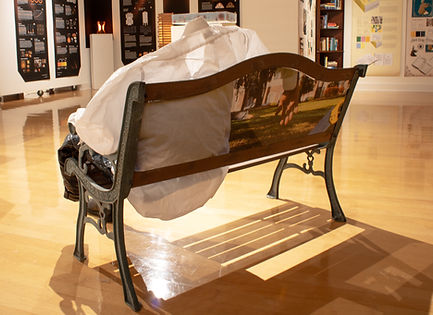


An incomplete figure occupies a public bench. The work functions as both invitation and exclusion asking whether access to public space necessarily equates to belonging .
I Shall Be Released
Plastic, metal, leather, human hair,
laser print on acetate, epoxy resin
Dimensions variable
2026


A severed leg remains tethered to a regulated landscape. Freedom is suggested, but access remains controlled. The work explores the tension between restriction and the promise of liberation.
I Contain Multitudes
Epoxy resin
20 x 12 x 3 ½ in
2026


A Pride celebration is visible yet encased within resin. Identity may be recognized publicly while still being contained. Identity is celebrated, recognized, and simultaneously regulated.
Ideas & Influences
Henri Lefebvre
Lefebvre's theory of the social production of space argues that public space is socially produced rather than neutral. Systems influence who may occupy, move through, and be visible within space.
Bob Dylan
Dylan's songs provide the titles for the series. I Contain Multitudes reflects his reinterpretation of Whitman's phrase, extending a dialogue between literature, music, and visual art.
Marcel Duchamp
Duchamp transformed ordinary objects into conceptual artworks. The public bench in The Public-Space Continuum similarly invites viewers to reconsider familiar objects.
Edward Kienholz
Kienholz combined found objects and imagery to create immersive environments. The integration of photography and sculpture in The Public-Space Continuum draws on this approach.
Flatland: A Romance of Many Dimensions
Edwin Abbott's novel explores the limits of perception and dimensional understanding. Photography and sculpture are combined to investigate relationships across dimensions.
Walt Whitman
"I contain multitudes" from poem "Song of Myself" suggests that identity is expansive, contradictory, and impossible to reduce to a single definition.
Robert Gober
Gober often employed partial body forms to evoke human presence. The cast leg in I Shall Be Released draws on this approach to suggest restriction and agency.
Reception Theory
Reception theory emphasizes the viewer's role in creating meaning. The Public-Space Continuum remains intentionally open to multiple interpretations.
Process



Initial Concept Sketch
The project began as an exploration of homelessness before evolving into a broader investigation of public space and social systems.
Simplification
As the project evolved, complexity gave way to clarity. Removing unnecessary elements allowed the work to ask questions rather than provide answers.
Separation
Separating the photograph from the cast leg transformed two connected components into independent elements. The resulting tension encourages viewers to construct the relationship between them.
Decapitation
Removing the photographic head shifted the figure from an individual narrative toward broader questions of access, belonging, and identity.
Accumulation
Built layer by layer, I Contain Multitudes reflects the way meaning emerges through accumulation. Individual forms become part of a larger whole, much like the social forces that shape public space.
That's a Wrap
The individual works were arranged as a continuum, allowing viewers to move between ideas of access, restriction, visibility, and identity.